

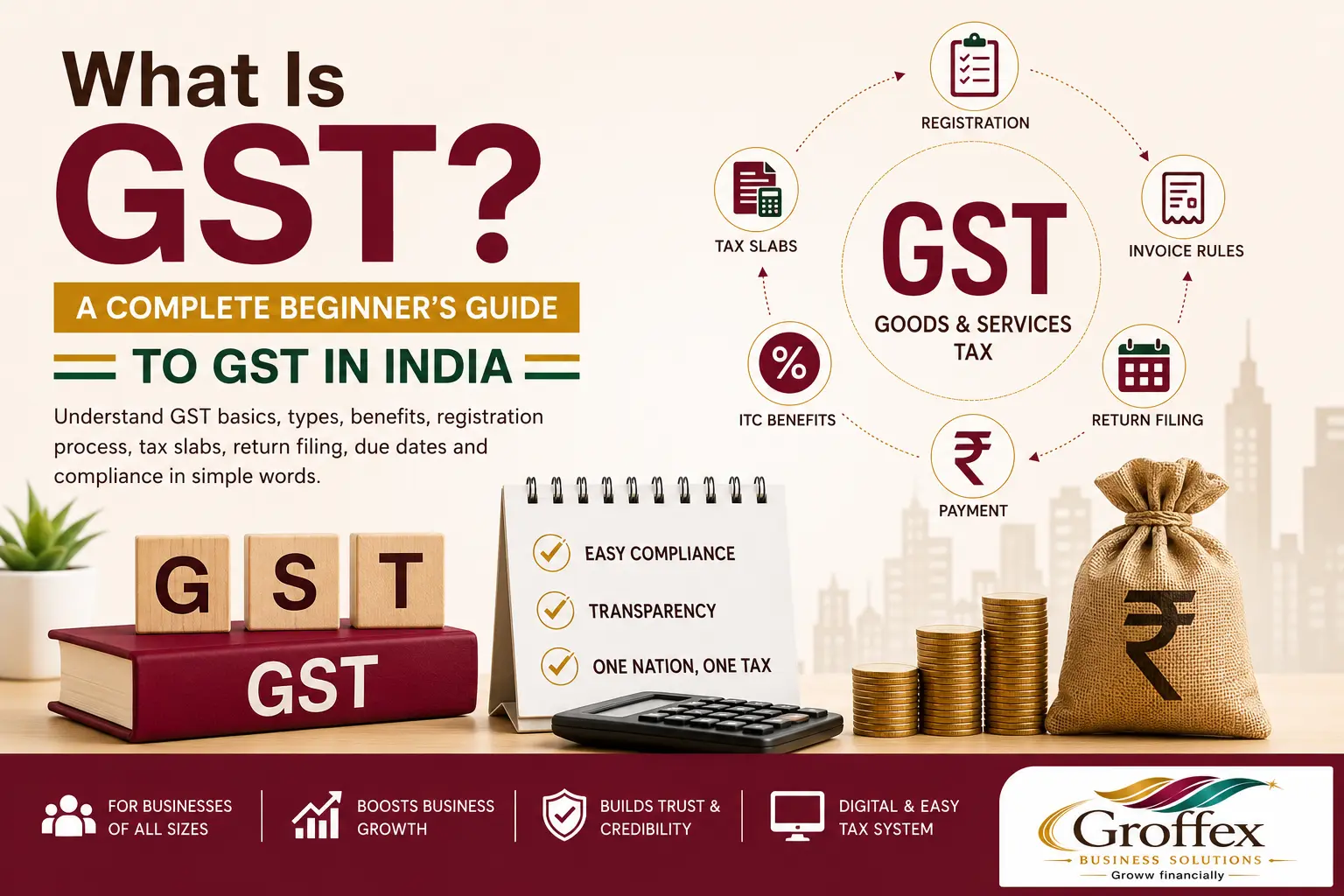
Whether you’re starting a new business, becoming a freelancer, or simply trying to understand taxation in India, you’ve probably heard the term GST (Goods and Services Tax). Since its introduction, GST has transformed India’s indirect tax system by replacing multiple taxes with a single, unified framework.
This guide from Groffex What is GST and explain in simple language so that business owners, startups, professionals, and individuals can understand how it works, who needs to register, what returns must be filed, and how GST impacts day-to-day business operations.
By the end of this guide, you’ll have a clear understanding of GST and be able to determine whether your business needs GST registration and ongoing compliance.
What Is GST?
GST (Goods and Services Tax) is an indirect tax imposed on the supply of goods and services in India. It replaced several indirect taxes such as VAT, Service Tax, Central Excise Duty, Entry Tax, Luxury Tax, and many others, creating a simplified tax system under one law.
Instead of charging different indirect taxes at different stages, What is GST follows the principle of “One Nation, One Tax.”
GST is collected at every stage of the supply chain. However, businesses can claim Input Tax Credit (ITC) on the GST paid for purchases, ensuring that tax is ultimately charged only on the value added at each stage.
Example
Suppose a manufacturer purchases raw materials worth ₹1,00,000 and pays GST on those purchases. When the manufacturer sells the finished product, GST is charged to the customer. The manufacturer can reduce the GST already paid on raw materials by claiming Input Tax Credit. This prevents double taxation and reduces the overall tax burden.
Why Was GST Introduced in India?
Before GST, India had a complex indirect tax system where businesses had to deal with multiple taxes imposed by both the Central Government and State Governments.
Some of the major taxes included:
- VAT
- Service Tax
- Excise Duty
- Entry Tax
- Purchase Tax
- Luxury Tax
- Entertainment Tax
- Octroi
Each tax had different rules, different authorities, and different compliance requirements.
This often resulted in:
- Double taxation
- Complex compliance
- Higher business costs
- Delays in interstate trade
- Tax cascading (tax on tax)
GST was introduced to eliminate these problems and create a transparent, technology-driven taxation system.
Objectives of GST
The primary objectives of GST are:
1. One Unified Tax System
GST replaced multiple indirect taxes with a single taxation framework applicable across India.
2. Eliminate Cascading Tax
Businesses can claim Input Tax Credit, ensuring tax is charged only on the value added.
3. Improve Ease of Doing Business
A simplified compliance system helps startups, SMEs, and large businesses operate more efficiently.
4. Increase Tax Transparency
Online registration, return filing, and payment processes improve accountability and reduce manual intervention.
5. Boost Economic Growth
A unified tax structure facilitates smoother interstate trade, lowers logistics costs, and contributes to overall economic efficiency.
Key Features of GST
GST offers several important features that benefit both businesses and consumers:
- One indirect tax system across India.
- Online GST registration and return filing.
- Input Tax Credit mechanism.
- Transparent digital compliance.
- Uniform tax rates for many goods and services.
- Improved interstate trade through seamless tax credits.
- Reduced tax cascading.
- Better tax administration using technology.
Why Choose Groffex for GST Services?
At Groffex, our team assists businesses, startups, professionals, NGOs, and companies with:
- GST Registration
- GST Return Filing
- GST Notice Handling
- GST Advisory
- GST Compliance Management
- GST Cancellation & Revocation
- Input Tax Credit Assistance
Our goal is to help businesses stay compliant while minimizing compliance risks through professional guidance.
Types of GST in India
India follows a dual GST model, where both the Central Government and State Governments levy taxes depending on the nature of the transaction. There are four types of GST:
1. Central Goods and Services Tax (CGST)
CGST is levied by the Central Government on intra-state transactions, meaning the supplier and the buyer are located in the same state or union territory.
Example
A business in Noida, Uttar Pradesh sells office furniture worth ₹50,000 to another business in Lucknow, Uttar Pradesh.
If the applicable GST rate is 18%, it will be divided equally:
- CGST: 9%
- SGST: 9%
The tax collected by the Central Government is known as CGST.
2. State Goods and Services Tax (SGST)
SGST is collected by the State Government on intra-state transactions.
In the above example, while the Central Government receives CGST, the Government of Uttar Pradesh receives SGST.
This sharing of tax revenue ensures that both governments receive their respective portions of GST.
3. Integrated Goods and Services Tax (IGST)
IGST is applicable when goods or services move from one state to another.
Example
A company in Delhi supplies software services to a client in Maharashtra.
Instead of charging CGST and SGST separately, the supplier charges IGST.
The Central Government collects the tax and later distributes the appropriate share to the destination state according to GST rules.
IGST simplifies interstate trade by eliminating multiple tax calculations and ensuring seamless input tax credit.
4. Union Territory Goods and Services Tax (UTGST)
UTGST applies to transactions occurring within Union Territories that do not have their own legislature.
Examples include:
- Andaman and Nicobar Islands
- Lakshadweep
- Dadra and Nagar Haveli and Daman and Diu
- Chandigarh
In these territories, CGST + UTGST are charged instead of CGST + SGST.
GST Tax Slabs in India
GST is charged at different rates depending on the nature of goods and services.
The commonly applicable GST tax slabs are:
| GST Rate | Generally Applicable To |
| 0% | Essential goods and selected exempt supplies |
| 5% | Essential household items and selected services |
| 12% | Processed goods and specific business services |
| 18% | Most goods and professional services |
| 28% | Luxury products and selected premium items |
Note: GST rates are determined by the Government and may change through official notifications. Businesses should verify the applicable rate before issuing invoices or filing returns.
Who Needs GST Registration?
GST registration is mandatory for certain businesses and optional for others, depending on turnover, business activities, and applicable legal provisions.
Generally, GST registration may be required for:
- Businesses whose turnover exceeds the prescribed threshold limits.
- Businesses making inter-state taxable supplies where registration is required under GST law.
- E-commerce sellers covered under GST provisions.
- Certain service providers.
- Casual taxable persons.
- Non-resident taxable persons.
- Businesses required to deduct or collect tax under GST.
- Input Service Distributors (ISD), where applicable.
If you are unsure whether registration is required for your business, consulting a qualified GST professional can help ensure compliance.
Mandatory vs Voluntary GST Registration
Mandatory Registration
GST registration becomes compulsory when a business falls under categories specified under the GST law, such as turnover-based thresholds or specific business activities.
Failure to register when legally required may lead to interest, penalties, and compliance issues.
Voluntary Registration
A business can also choose to obtain GST registration even if it is not legally mandatory.
Benefits of Voluntary Registration
- Improves business credibility.
- Enables claiming eligible Input Tax Credit (ITC).
- Facilitates dealing with GST-registered clients.
- Supports expansion into larger markets.
- Helps meet vendor and customer requirements.
Many startups and growing businesses opt for voluntary registration to establish credibility and prepare for future growth.
Documents Required for GST Registration
The exact documentation depends on the type of business entity. Commonly required documents include:
For Proprietorship
- PAN of the proprietor
- Aadhaar (where applicable)
- Business address proof
- Bank account details
- Photograph of the proprietor
For Partnership Firms
- PAN of the firm
- Partnership deed
- Address proof
- Bank account details
- Identity and address proof of partners
For Private Limited Companies / LLPs
- PAN of the company or LLP
- Certificate of Incorporation
- PAN and identity proof of directors or designated partners
- Business address proof
- Bank account details
- Board Resolution or authorization letter, where applicable
Important: Additional documents may be required depending on the business type, registration category, or specific GST requirements.
Step-by-Step GST Registration Process
The GST registration process is conducted online through the official GST portal.
Step 1: Determine Eligibility
Check whether your business is required or eligible for GST registration based on applicable legal provisions.
Step 2: Gather Required Documents
Prepare all necessary documents in advance to avoid delays during the application process.
Step 3: Submit the Online Application
Complete the registration application with accurate business details and upload the required documents.
Step 4: Verification
The application is reviewed by the GST authorities. Additional clarification or documentation may be requested if required.
Step 5: Receive GSTIN
Upon successful approval, the business is allotted a Goods and Services Tax Identification Number (GSTIN), which is used for issuing GST-compliant invoices, filing returns, and maintaining tax compliance.
How Groffex Can Help
GST registration involves more than just submitting an application. Incorrect information or missing documents can lead to delays or notices.
At Groffex, we assist businesses with:
- GST registration guidance
- Document verification
- Application filing
- GSTIN assistance
- Post-registration compliance support
- Ongoing GST advisory and return filing services
Our objective is to help businesses complete the registration process accurately and remain compliant with applicable GST laws.
What is GSTIN?
A GSTIN (Goods and Services Tax Identification Number) is a unique 15-digit identification number issued to businesses registered under the Goods and Services Tax (GST) system in India.
Every registered taxpayer uses their GSTIN for:
- Issuing GST-compliant tax invoices
- Filing GST returns
- Paying GST
- Claiming eligible Input Tax Credit (ITC)
- Conducting GST-related business transactions
A GSTIN helps the government identify registered taxpayers and maintain a transparent tax administration system.
Structure of a GSTIN
A GSTIN consists of 15 alphanumeric characters:
- First 2 digits: State code
- Next 10 characters: PAN of the business or taxpayer
- 13th digit: Entity number under the same PAN
- 14th digit: Default alphabet “Z”
- 15th digit: Checksum digit generated by the system
Example (Illustrative Only):
09ABCDE1234F1Z5
Note: The above GSTIN is provided only to explain the format and is not a valid registration number.
What is GST Composition Scheme?
The Composition Scheme is a simplified taxation scheme designed for certain eligible small taxpayers under the GST framework.
Instead of following the regular GST compliance process, eligible businesses opting for the Composition Scheme pay tax at prescribed rates and benefit from simplified return filing requirements, subject to applicable GST rules.
Key Features
- Simplified compliance
- Reduced record-keeping requirements
- Lower compliance burden for eligible businesses
- Suitable for certain small taxpayers, subject to legal eligibility
Important Points
Businesses registered under the Composition Scheme generally:
- Cannot collect GST from customers in the same manner as regular taxpayers.
- Cannot claim Input Tax Credit (ITC), subject to applicable provisions.
- Must comply with conditions prescribed under GST law.
Important: Eligibility criteria, turnover limits, and applicable rates may change through government notifications. Businesses should verify current provisions before opting for the scheme.
What is Input Tax Credit (ITC)?
Input Tax Credit (ITC) is one of the most important features of the GST system.
It allows eligible registered businesses to claim credit for the GST paid on purchases used in the course or furtherance of business, subject to the conditions prescribed under the GST law.
This helps prevent double taxation by ensuring that tax is effectively paid only on the value added at each stage of the supply chain.
Example of Input Tax Credit
Suppose:
- You purchase goods worth ₹1,00,000
- GST paid on purchase = ₹18,000
Later, you sell the goods and collect:
- Output GST = ₹30,000
If all legal conditions for claiming ITC are satisfied:
- Output GST = ₹30,000
- Less: Eligible ITC = ₹18,000
Net GST payable = ₹12,000
This mechanism reduces the overall tax burden and promotes tax efficiency.
Conditions for Claiming ITC
To claim Input Tax Credit, businesses generally need to satisfy applicable legal requirements, including:
- Valid tax invoice or prescribed document.
- Receipt of goods or services.
- Supplier has furnished required GST details, where applicable.
- GST returns filed within prescribed timelines.
- Compliance with other applicable GST provisions.
Businesses should maintain proper documentation and records to support ITC claims.
GST Invoice Rules
A GST invoice is an important legal document that records the supply of goods or services.
A proper tax invoice generally includes:
- Supplier name
- GSTIN of supplier
- Invoice number
- Invoice date
- Customer details (where applicable)
- GSTIN of recipient (if registered)
- Description of goods or services
- Quantity
- Taxable value
- Applicable GST rate
- CGST, SGST, IGST or UTGST, as applicable
- Total invoice value
- Authorized signatory (where required)
Maintaining accurate invoices is essential for return filing, audits, and claiming Input Tax Credit.
GST Return Filing
GST return filing is the process through which registered taxpayers report their business transactions, tax liability, and eligible credits to the GST authorities.
The type of return depends on the nature of the business and the applicable GST provisions.
Some commonly known GST returns include:
GSTR-1
GSTR-1 contains details of outward supplies (sales).
It includes:
- B2B invoices
- B2C supplies
- Credit Notes
- Debit Notes
- Export supplies (where applicable)
GSTR-3B
GSTR-3B is a summary return used to declare:
- Taxable sales
- Eligible Input Tax Credit
- Tax payable
- Tax paid
Many registered taxpayers are required to file GSTR-3B as per applicable GST provisions.
GSTR-9
GSTR-9 is the Annual Return that consolidates information relating to outward supplies, inward supplies, taxes paid, and Input Tax Credit for a financial year, where applicable.
Other GST Returns
Depending on the taxpayer category, additional returns may apply under the GST framework.
The applicable return forms should always be determined based on the business type and prevailing GST rules.
GST Payment Process
GST payment is generally completed through the GST portal after calculating the tax liability.
The typical process involves:
Step 1
Calculate total GST liability.
Step 2
Adjust eligible Input Tax Credit, where permissible.
Step 3
Generate the payment challan.
Step 4
Make payment using approved payment methods.
Step 5
File the applicable GST return within the prescribed timeline.
Maintaining accurate books of accounts helps ensure correct tax calculations and timely compliance.
GST Due Dates
GST due dates vary depending on:
- Type of taxpayer
- Nature of registration
- Applicable return
- Government notifications
- Compliance category
Since due dates may change from time to time, taxpayers should always refer to the latest notifications issued by the Government or consult a qualified GST professional before filing returns.
Note: Avoid publishing static due dates in an evergreen guide, as they may become outdated. Instead, create a separate “Latest GST Due Dates” page and update it regularly.
Common GST Compliance Requirements
Maintaining GST compliance involves more than filing returns. Businesses should also:
- Issue GST-compliant invoices.
- Maintain accurate books of accounts.
- Reconcile purchase and sales records.
- Preserve invoices and supporting documents.
- File applicable returns on time.
- Pay GST within prescribed timelines.
- Monitor notices or communications received from GST authorities.
- Review Input Tax Credit eligibility periodically.
Consistent compliance helps reduce the risk of notices, penalties, and operational disruptions.
How Groffex Supports GST Compliance ?
Managing GST compliance can be time-consuming, especially for growing businesses. At Groffex, we assist clients with:
- GST Registration
- GST Return Filing
- GSTIN-related assistance
- Input Tax Credit guidance
- GST Notice Reply
- GST Reconciliation
- GST Compliance Management
- Annual GST support
Our approach focuses on helping businesses maintain accurate records and comply with applicable GST requirements through professional assistance.
Benefits of GST
The introduction of the Goods and Services Tax (GST) has simplified India’s indirect tax system and made tax compliance more transparent and technology-driven. While businesses must meet their compliance obligations, GST also offers several advantages for eligible taxpayers.
1. One Nation, One Tax
Before GST, businesses had to deal with multiple indirect taxes imposed by different authorities. GST introduced a unified tax framework, reducing complexity and making compliance easier.
2. Elimination of Cascading Tax
One of the biggest advantages of GST is the Input Tax Credit (ITC) mechanism. Eligible businesses can claim credit for GST paid on purchases, helping avoid the “tax on tax” effect and reducing the overall tax burden.
3. Simplified Compliance
Most GST processes—including registration, return filing, tax payments, and application tracking—are completed online, making compliance faster and more transparent.
4. Better Business Credibility
A GST-registered business often appears more credible to customers, vendors, and financial institutions, particularly when dealing with B2B clients.
5. Improved Interstate Trade
GST replaced several state-specific taxes, making it easier for businesses to supply goods and services across India under a common tax framework.
6. Increased Transparency
The online GST system encourages proper record-keeping and helps create a transparent tax environment.
7. Supports Business Growth
As businesses expand, a structured GST compliance process can support smoother operations, vendor relationships, and financial management.
8. Digital Tax Administration
GST promotes paperless compliance through online registrations, return filing, tax payments, and document management.
9. Better Record Management
Businesses maintaining accurate GST records often benefit from improved financial reporting and smoother statutory compliance.
10. Easier Access to Business Opportunities
Many government departments, large companies, and corporate buyers prefer working with GST-registered vendors, depending on procurement requirements.
Common GST Mistakes to Avoid
Even experienced businesses can make GST compliance mistakes. Avoiding these common errors can help reduce the risk of notices, interest, or penalties.
1. Delaying GST Registration
Businesses that are required to register under GST should complete the registration process within the applicable timelines.
2. Filing Returns After the Due Date
Late filing may result in additional compliance consequences, including interest or late fees, where applicable.
3. Incorrect GSTIN on Invoices
Always verify the GSTIN before issuing invoices. Incorrect details can create reconciliation and compliance issues.
4. Claiming Ineligible Input Tax Credit
Only claim ITC when all applicable legal conditions are satisfied and proper documentation is available.
5. Ignoring GST Notices
If you receive a communication or notice from the GST department, review it carefully and respond within the prescribed timelines.
6. Maintaining Poor Accounting Records
Accurate bookkeeping helps ensure correct GST calculations, return filing, and ITC reconciliation.
7. Using Incorrect GST Rates
Applying the wrong GST rate can lead to short payment or excess collection of tax. Always verify the applicable rate for your goods or services.
8. Forgetting Annual Compliance
Businesses should review all applicable annual GST compliance requirements, where relevant.
9. Not Reconciling Sales and Purchase Data
Regular reconciliation helps identify mismatches early and supports accurate return filing.
10. Not Seeking Professional Advice
GST laws evolve over time. Consulting qualified professionals can help businesses understand and comply with current requirements.
Conclusion
GST has significantly transformed India’s indirect tax system by creating a more unified, transparent, and technology-driven framework for the taxation of goods and services. Understanding the fundamentals of What is GST—including registration, GSTIN, tax types, Input Tax Credit, return filing, invoicing, and compliance—is essential for businesses that want to operate efficiently and remain compliant with applicable laws.
Whether you are a startup, freelancer, small business, or established company, staying informed about GST requirements and maintaining accurate financial records can help reduce compliance risks and support long-term business growth.
Because GST laws, notifications, and compliance requirements may change over time, businesses should regularly review official updates and seek professional guidance whenever needed.
Related post:-
New Income Tax Act 2026 for Salaried Employees | Groffex Guide
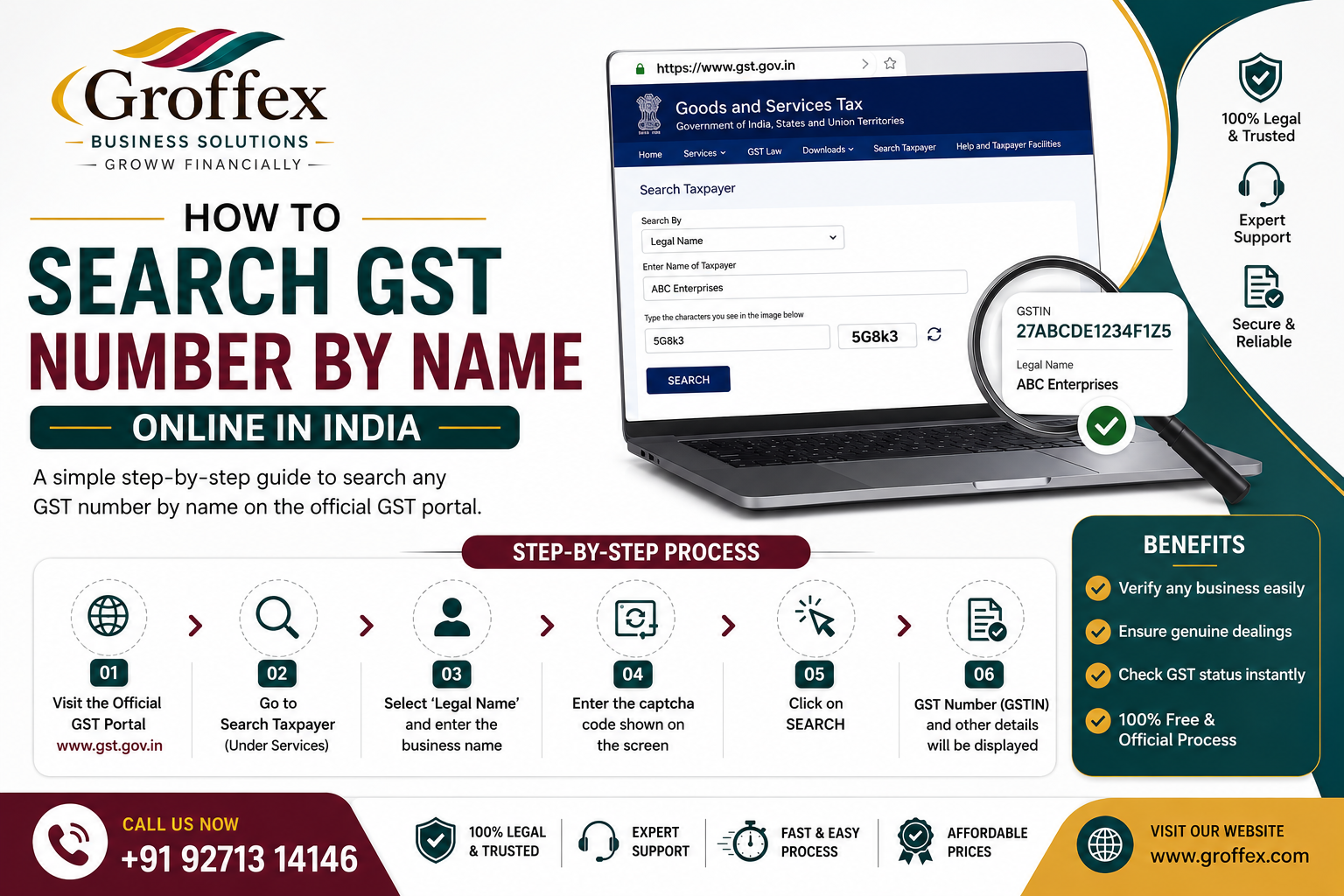
How to Search GST Number by Name Online in India: Complete Guide
What is GST?
GST (Goods and Services Tax) is an indirect tax applicable to the supply of goods and services in India. It replaced several indirect taxes with a unified tax system.
Who needs GST registration?
GST registration requirements depend on factors such as turnover, business activities, and applicable legal provisions. Businesses should review the latest GST rules or consult a qualified professional.
Is GST registration mandatory for every business?
No. Registration is mandatory only in cases specified under the GST law. Some businesses may also choose voluntary registration.
What are the different types of GST?
The four types of GST are:
CGST
SGST
IGST
UTGST
Can a small business register voluntarily under GST?
Yes. Eligible businesses may choose voluntary registration even when it is not legally mandatory.
How long does GST registration take?
Processing time depends on the completeness of the application, document verification, and GST authority procedures.
Is GST applicable to services?
Yes. GST applies to many goods and services, subject to the applicable tax rates, exemptions, and legal provisions.
Where can I get professional GST assistance?
Businesses seeking assistance with GST registration, return filing, compliance, or notices can consult qualified tax professionals such as the team at Groffex.
What is Input Tax Credit (ITC)?
Input Tax Credit allows eligible businesses to claim credit for GST paid on business purchases, subject to applicable conditions.
What is GSTR-1,GSTR-3B and GSTR-9?
GSTR-1 is a return containing details of outward supplies (sales), where applicable.
GSTR-3B is a summary GST return used to report tax liability, eligible credits, and tax payments, as applicable.
GSTR-9 is the annual return applicable to eligible registered taxpayers under GST provisions.